The decentralized nature of wireless ad hoc networks makes them suitable for a variety of applications where central nodes can't be relied on, and may improve the scalability of wireless ad hoc networks compared to wireless managed networks, though theoretical[2] and practical[3] limits to the overall capacity of such networks have been identified.
Minimal configuration and quick deployment make ad hoc networks suitable for emergency situations like natural disasters or military conflicts. The presence of a dynamic and adaptive routing protocol will enable ad hoc networks to be formed quickly.
Wireless ad hoc networks can be further classified by their application:
mobile ad hoc networks (MANETs) wireless mesh networks wireless sensor networks.
Refrence:http://en.wikipedia.org/wiki/Wireless_ad_hoc_network
Wireless Ad Hoc Sensor Networks


A wireless ad hoc sensor network consists of a number of sensors spread across a geographical area. Each sensor has wireless communication capability and some level of intelligence for signal processing and networking of the data. Some examples of wireless ad hoc sensor networks are the following:
- Military sensor networks to detect and gain as much information as possible about enemy movements, explosions, and other phenomena of interest.
- Sensor networks to detect and characterize Chemical, Biological, Radiological, Nuclear, and Explosive (CBRNE) attacks and material.
- Sensor networks to detect and monitor environmental changes in plains, forests, oceans, etc.
- Wireless traffic sensor networks to monitor vehicle traffic on highways or in congested parts of a city.
- Wireless surveillance sensor networks for providing security in shopping malls, parking garages, and other facilities.
- Wireless parking lot sensor networks to determine which spots are occupied and which are free.
The above list suggests that wireless ad hoc sensor networks offer certain capabilities and enhancements in operational efficiency in civilian applications as well as assist in the national effort to increase alertness to potential terrorist threats.Two ways to classify wireless ad hoc sensor networks are whether or not the nodes are individually addressable, and whether the data in the network is aggregated. The sensor nodes in a parking lot network should be individually addressable, so that one can determine the locations of all the free spaces. This application shows that it may be necessary to broadcast a message to all the nodes in the network. If one wants to determine the temperature in a corner of a room, then addressability may not be so important. Any node in the given region can respond. The ability of the sensor network to aggregate the data collected can greatly reduce the number of messages that need to be transmitted across the network. This function of data fusion is discussed more below.The basic goals of a wireless ad hoc sensor network generally depend upon the application, but the following tasks are common to many networks:
- Determine the value of some parameter at a given location: In an environmental network, one might one to know the temperature, atmospheric pressure, amount of sunlight, and the relative humidity at a number of locations. This example shows that a given sensor node may be connected to different types of sensors, each with a different sampling rate and range of allowed values.
- Detect the occurrence of events of interest and estimate parameters of the detected event or events: In the traffic sensor network, one would like to detect a vehicle moving through an intersection and estimate the speed and direction of the vehicle.
- Classify a detected object: Is a vehicle in a traffic sensor network a car, a mini-van, a light truck, a bus, etc.
- Track an object: In a military sensor network, track an enemy tank as it moves through the geographic area covered by the network.
In these four tasks, an important requirement of the sensor network is that the required data be disseminated to the proper end users. In some cases, there are fairly strict time requirements on this communication. For example, the detection of an intruder in a surveillance network should be immediately communicated to the police so that action can be taken.
Wireless ad hoc sensor network requirements include the following:
- Large number of (mostly stationary) sensors: Aside from the deployment of sensors on the ocean surface or the use of mobile, unmanned, robotic sensors in military operations, most nodes in a smart sensor network are stationary. Networks of 10,000 or even 100,000 nodes are envisioned, so scalability is a major issue.
- Low energy use: Since in many applications the sensor nodes will be placed in a remote area, service of a node may not be possible. In this case, the lifetime of a node may be determined by the battery life, thereby requiring the minimization of energy expenditure.
- Network self-organization: Given the large number of nodes and their potential placement in hostile locations, it is essential that the network be able to self-organize; manual configuration is not feasible. Moreover, nodes may fail (either from lack of energy or from physical destruction), and new nodes may join the network. Therefore, the network must be able to periodically reconfigure itself so that it can continue to function. Individual nodes may become disconnected from the rest of the network, but a high degree of connectivity must be maintained.
- Collaborative signal processing: Yet another factor that distinguishes these networks from MANETs is that the end goal is detection/estimation of some events of interest, and not just communications. To improve the detection/estimation performance, it is often quite useful to fuse data from multiple sensors. This data fusion requires the transmission of data and control messages, and so it may put constraints on the network architecture.
- Querying ability: A user may want to query an individual node or a group of nodes for information collected in the region. Depending on the amount of data fusion performed, it may not be feasible to transmit a large amount of the data across the network. Instead, various local sink nodes will collect the data from a given area and create summary messages. A query may be directed to the sink node nearest to the desired location.
Sensor types and system architecture:
With the coming availability of low cost, short range radios along with advances in wireless networking, it is expected that wireless ad hoc sensor networks will become commonly deployed. In these networks, each node may be equipped with a variety of sensors, such as acoustic, seismic, infrared, still/motion videocamera, etc. These nodes may be organized in clusters such that a locally occurring event can be detected by most of, if not all, the nodes in a cluster. Each node may have sufficient processing power to make a decision, and it will be able to broadcast this decision to the other nodes in the cluster. One node may act as the cluster master, and it may also contain a longer range radio using a protocol such as IEEE 802.11 or Bluetooth.
source: itl.nist.gov/div892/wahn_ssn.shtml

Sensor node
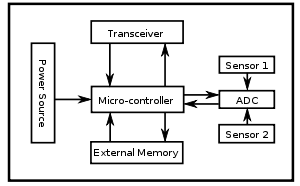 A sensor node, also known as a 'mote' (chiefly in North America), is a node in a wireless sensor network that is capable of performing some processing, gathering sensory information and communicating with other connected nodes in the network. The typical architecture of the sensor node is shown in figure.
Components of a Sensor Node
The main components of a sensor node as seen from the figure are microcontroller, transceiver, external memory, power source and one or more sensors.
Microcontroller
Microcontroller performs tasks, processes data and controls the functionality of other components in the sensor node. Other alternatives that can be used as a controller are: General purpose desktop microprocessor, Digital signal processors, Field Programmable Gate Array and Application-specific integrated circuit. Microcontrollers are most suitable choice for sensor node. Each of the four choices has their own advantages and disadvantages. Microcontrollers are the best choices for embedded systems. Because of their flexibility to connect to other devices, programmable, power consumption is less, as these devices can go to sleep state and part of controller can be active. In general purpose microprocessor the power consumption is more than the microcontroller, therefore it is not a suitable choice for sensor node. Digital Signal Processors are appropriate for broadband wireless communication. But in Wireless Sensor Networks, the wireless communication should be modest i.e., simpler, easier to process modulation and signal processing tasks of actual sensing of data is less complicated. Therefore the advantages of DSP's is not that much of importance to wireless sensor node. Field Programmable Gate Arrays can be reprogrammed and reconfigured according to requirements, but it takes time and energy. Therefore FPGA's is not advisable. Application Specific Integrated Circuits are specialized processors designed for a given application. ASIC's provide the functionality in the form of hardware, but microcontrollers provide it through software.
Transceiver
Sensor nodes make use of ISM band which gives free radio, huge spectrum allocation and global availability. The various choices of wireless transmission media are Radio frequency, Optical communication (Laser) and Infrared. Laser requires less energy, but needs line-of-sight for communication and also sensitive to atmospheric conditions. Infrared like laser, needs no antenna but is limited in its broadcasting capacity. Radio Frequency (RF) based communication is the most relevant that fits to most of the WSN applications. WSN’s use the communication frequencies between about 433 MHz and 2.4 GHz. The functionality of both transmitter and receiver are combined into a single device know as transceivers are used in sensor nodes. Transceivers lack unique identifier. The operational states are Transmit, Receive, Idle and Sleep.
Current generation radios have a built-in state machines that perform this operation automatically. Radios used in transceivers operate in four different modes: Transmit, Receive, Idle, and Sleep. Radios operating in Idle mode results in power consumption, almost equal to power consumed in Receive mode [4]. Thus it is better to completely shutdown the radios rather than in the Idle mode when it is not Transmitting or Receiving. And also significant amount of power is consumed when switching from Sleep mode to Transmit mode to transmit a packet.
External Memory
From an energy perspective, the most relevant kinds of memory are on-chip memory of a microcontroller and FLASH memory - off-chip RAM is rarely if ever used. Flash memories are used due to its cost and storage capacity. Memory requirements are very much application dependent. Two categories of memory based on the purpose of storage a) User memory used for storing application related or personal data. b) Program memory used for programming the device. This memory also contains identification data of the device if any.
Power Source
Power consumption in the sensor node is for the Sensing, Communication and Data Processing. More energy is required for data communication in sensor node. Energy expenditure is less for sensing and data processing. The energy cost of transmitting 1 Kb a distance of 100 m is approximately the same as that for the executing 3 million instructions by 100 million instructions per second/W processor. Power is stored either in Batteries or Capacitors. Batteries are the main source of power supply for sensor nodes. Namely two types of batteries used are chargeable and non-rechargeable. They are also classified according to electrochemical material used for electrode such as NiCd(nickel-cadmium), NiZn(nickel-zinc), Nimh (nickel metal hydride), and Lithium-Ion. Current sensors are developed which are able to renew their energy from solar, thermogenerator, or vibration energy. Two major power saving policies used are Dynamic Power Management (DPM) and Dynamic Voltage Scaling (DVS)[5]. DPM takes care of shutting down parts of sensor node which are not currently used or active. DVS scheme varies the power levels depending on the non-deterministic workload. By varying the voltage along with the frequency, it is possible to obtain quadratic reduction in power consumption.
Sensors
Sensors are hardware devices that produce measurable response to a change in a physical condition like temperature and pressure. Sensors sense or measure physical data of the area to be monitored. The continual analog signal sensed by the sensors is digitized by an Analog-to-digital converter and sent to controllers for further processing. Characteristics and requirements of Sensor node should be small size, consume extremely low energy, operate in high volumetric densities, be autonomous and operate unattended, and be adaptive to the environment. As wireless sensor nodes are micro-electronic sensor device, can only be equipped with a limited power source of less than 0.5 Ah and 1.2 V. Sensors are classified into three categories.
- Passive, Omni Directional Sensors: Passive sensors sense the data without actually manipulating the environment by active probing. They are self powered i.e energy is needed only to amplify their analog signal. There is no notion of “direction” involved in these measurements.
- Passive, narrow-beam sensors: These sensors are passive but they have well-defined notion of direction of measurement. Typical example is ‘camera’.
- Active Sensors: These group of sensors actively probe the environment, for example, a sonar or radar sensor or some type of seismic sensor, which generate shock waves by small explosions.
The overall theoretical work on WSN’s considers Passive, Omni directional sensors. Each sensor node has a certain area of coverage for which it can reliably and accurately report the particular quantity that it is observing. Several sources of power consumption in sensors are a) Signal sampling and conversion of physical signals to electrical ones, b) signal conditioning, and c) analog-to-digital conversion. Spatial density of sensor nodes in the field may be as high as 20 nodes/ m3 .
References^ Smart Dust
^ Home
^ CENS: Center for Embedded Networked Sensing
^ Y. Xu, J. Heidemann, and D. Estrin, Geography-informed energy conservation for ad-hoc routing, in Proc. Mobicom, 2001, pp. 70-84
^ Dynamic Power Management in Wireless Sensor Networks, Amit Sinha and Anantha Chandrakasan, IEEE Design & Test of Computers, Vol. 18, No. 2, March-April 2001
Wireless local loop

Wireless local loop (WLL), is a term for the use of a wireless communications link as the "last mile / first mile" connection for delivering plain old telephone service (POTS) and/or broadband Internet to telecommunications customers. Various types of WLL systems and technologies exist.
Definition of Fixed Wireless Service
Fixed Wireless Terminal (FWT) units differ from conventional mobile terminal units operating within cellular networks - such as GSM - in that a fixed wireless terminal or desk phone will be limited to an almost permanent location with almost no roaming abilities.
WLL and FWTs are generic terms for radio based telecommunications technologies and the respective devices which can be implemented using a number of different wireless and radio technologies.
Wireless Local Loop service is segmented into a number of broad market and deployment groups. Services are split between Licensed - commonly used by Carriers and Telcos - and Unlicensed services more commonly deployed by home users and Wireless ISPs (WISPs
References
^ Sprint, Clearwire Near WiMax Deal - TheStreet.com
2. "Telecommunications Technology Expert". Archived from the original 2009-06-02. ims-expertservices.com. Retrieved on 2009-06-18
^ Sprint, Clearwire Near WiMax Deal - TheStreet.com
2. "Telecommunications Technology Expert". Archived from the original 2009-06-02. ims-expertservices.com. Retrieved on 2009-06-18
Wireless sensor network
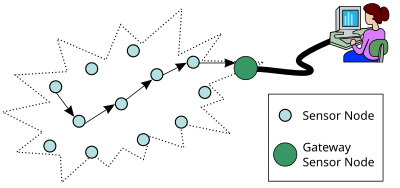
A wireless sensor network (WSN) is a wireless network consisting of spatially distributed autonomous devices using sensors to cooperatively monitor physical or environmental conditions, such as temperature, sound, vibration, pressure, motion or pollutants, at different locations.[1][2] The development of wireless sensor networks was originally motivated by military applications such as battlefield surveillance. However, wireless sensor networks are now used in many industrial and civilian application areas, including industrial process monitoring and control, machine health monitoring, environment and habitat monitoring, healthcare applications, home automation, and traffic control.[1][3]
In addition to one or more sensors, each node in a sensor network is typically equipped with a radio transceiver or other wireless communications device, a small microcontroller, and an energy source, usually a battery. The envisaged size of a single sensor node can vary from shoebox-sized nodes down to devices the size of grain of dust,[1] although functioning 'motes' of genuine microscopic dimensions have yet to be created. The cost of sensor nodes is similarly variable, ranging from hundreds of dollars to a few pence , depending on the size of the sensor network and the complexity required of individual sensor nodes.[1] Size and cost constraints on sensor nodes result in corresponding constraints on resources such as energy, memory, computational speed and bandwidth.[1]
In addition to one or more sensors, each node in a sensor network is typically equipped with a radio transceiver or other wireless communications device, a small microcontroller, and an energy source, usually a battery. The envisaged size of a single sensor node can vary from shoebox-sized nodes down to devices the size of grain of dust,[1] although functioning 'motes' of genuine microscopic dimensions have yet to be created. The cost of sensor nodes is similarly variable, ranging from hundreds of dollars to a few pence , depending on the size of the sensor network and the complexity required of individual sensor nodes.[1] Size and cost constraints on sensor nodes result in corresponding constraints on resources such as energy, memory, computational speed and bandwidth.[1]
refrence:http://en.wikipedia.org/
Applications of wireless technology
Security systems
Wireless technology may supplement or replace hard wired implementations in security systems for homes or office buildings.
[edit] Television remote control
Modern televisions use wireless (generally infrared) remote control units. Now radio waves are also used.
[edit] Cellular telephony (phones and modems)
Perhaps the best known example of wireless technology is the cellular telephone and modems. These instruments use radio waves to enable the operator to make phone calls from many locations world-wide. They can be used anywhere that there is a cellular telephone site to house the equipment that is required to transmit and receive the signal that is used to transfer both voice and data to and from these instruments.
refrence:http://en.wikipedia.org
Wireless communication

The term "wireless" has become a generic and all-encompassing word used to describe communications in which electromagnetic waves or RF (rather than some form of wire) carry a signal over part or the entire communication path. Common examples of wireless equipment in use today include:
Professional LMR (Land Mobile Radio) and SMR (Specialized Mobile Radio) typically used by business, industrial and Public Safety entities
Consumer Two Way Radio including FRS (Family Radio Service), GMRS (General Mobile Radio Service) and Citizens band ("CB") radios
The Amateur Radio Service (Ham radio)
Consumer and professional Marine VHF radios
Cellular telephones and pagers: provide connectivity for portable and mobile applications, both personal and business.
Global Positioning System (GPS): allows drivers of cars and trucks, captains of boats and ships, and pilots of aircraft to ascertain their location anywhere on earth.
Cordless computer peripherals: the cordless mouse is a common example; keyboards and printers can also be linked to a computer via wireless.
Cordless telephone sets: these are limited-range devices, not to be confused with cell phones.
Satellite television: allows viewers in almost any location to select from hundreds of channels.
Wireless gaming: new gaming consoles allow players to interact and play in the same game regardless of whether they are playing on different consoles. Players can chat, send text messages as well as record sound and send it to their friends. Controllers also use wireless technology. They do not have any cords but they can send the information from what is being pressed on the controller to the main console which then processes this information and makes it happen in the game. All of these steps are completed in milliseconds.
Wireless networking (i.e. the various types of unlicensed 2.4 GHz WiFi devices) is used to meet many needs. Perhaps the most common use is to connect laptop users who travel from location to location. Another common use is for mobile networks that connect via satellite. A wireless transmission method is a logical choice to network a LAN segment that must frequently change locations. The following situations justify the use of wireless technology:
To span a distance beyond the capabilities of typical cabling,
To avoid obstacles such as physical structures, EMI, or RFI,
To provide a backup communications link in case of normal network failure,
To link portable or temporary workstations,
To overcome situations where normal cabling is difficult or financially impractical, or
To remotely connect mobile users or networks.
Wireless communication can be via:
radio frequency communication,
microwave communication, for example long-range line-of-sight via highly directional antennas, or short-range communication, or
infrared (IR) short-range communication, for example from remote controls or via Infrared Data Association (IrDA).
Applications may involve point-to-point communication, point-to-multipoint communication, broadcasting, cellular networks and other wireless networks.
The term "wireless" should not be confused with the term "cordless", which is generally used to refer to powered electrical or electronic devices that are able to operate from a portable power source (e.g. a battery pack) without any cable or cord to limit the mobility of the cordless device through a connection to the mains power supply. Some cordless devices, such as cordless telephones, are also wireless in the sense that information is transferred from the cordless telephone to the telephone's base unit via some type of wireless communications link. This has caused some disparity in the usage of the term "cordless", for example in Digital Enhanced Cordless Telecommunications.
refrence:http://en.wikipedia.org/


 Posts


